At a time when automated text generators and AI can create polished, yet often standardized application portfolios, teenage authors of autobiographical college essay stand at a crossroads. Many often (mis)perceive the personal statement as a marketing obstacle, a final opportunity to convince an admissions officer of their worthiness. But education is not a negotiation, nor…

Tag: University of California (UC)
Balancing College Applications and Senior-Year Schoolwork
Many seniors worry about spending “enough time” on college applications, especially when autobiographical essays, college research, and application tasks compete with schoolwork. But the deeper challenge is decision-making. Seniors are learning, in real time, how to weigh competing priorities under uncertainty. Should they revise or review their autobiographical college essay or study for tomorrow’s test?…
College Readiness Is About More Than Academics
Since many students move away from home to attend college, parents’ concerns about “college readiness” often extends beyond academic preparation. Many seek confidence in their teenage child’s ability to manage the inevitable challenges of life. So, while parents often need to see that their student can do laundry, maintain a budget, cook a nutritious meal,…
College Admissions: A Lesson in Managing Uncertainty
During the college admissions process, families are managing uncertainty, not simply making educational decisions. Adding complexity, parents and teenagers often approach dealing with ambiguity from two different time horizons. Parents often approach college planning from a long-term perspective, what Lewis Lapham called, “the wisdom of earned experience”. Parents may act based on regrets of missed…
The Quiet Shift Before College Admissions
Long before college applications are submitted, students often miss the opportunity to understand the meaning of their experiences. Often, students “collect” experiences, too focused on acceptance rates and admissions policies, not pausing to understand what they’re learning. So, Is Experience: Teacher or Currency? Every day, students expend effort. Thus, experience can be a “teacher”, where…
College Admissions: A Path to Humanness
Since preschool, students have progressed through school and life as part of groups, amongst same-aged peers, taking similar classes, choosing from overlapping activities. However, in planning for college, each student is now confronting something fundamentally different: choosing a path based on who they are becoming. And yet, “group think” doesn’t simply disappear. Many students continue…
Choosing a College Is a Leap of Faith—But It Doesn’t Have to Be a Blind One
Choosing a college is, in many ways, a leap of faith. Students are committing four years pivotal years of their lives, transitioning from childhood to adulthood, not to mention making a significant financial investment, and without knowing exactly the experience once the excitement of move-in day fades. Taking a campus tour, families can learn the…
Some Perspective for Sophomore Families
Every spring, many sophomore families seek more strategic college admissions advising. With high school at the halfway point, suddenly each choice seems to have greater consequence: A grade slips, managing more advanced coursework is challenging, long-term extracurricular commitments are sometimes questioned. Seemingly overnight, the conversation at the dinner table becomes a strategic planning session: Parents…
“March Madness”: Waiting for College Admissions Decision
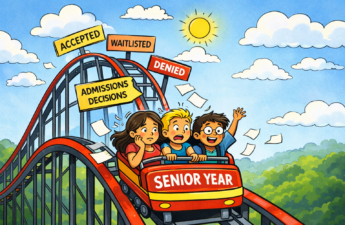
For high school seniors, instead of March Madness basketball brackets, families are watching applicant portals, eagerly anticipating admissions results, both from Regular Decision and if deferred from early admissions. Many experience mixed emotions—excitement, disappointment, relief, and confusion—sometimes, from one click to the next. Most are experiencing the years’ long build-up of expectations plus an “acceptance”…
Writing Under Pressure
For seniors applying to highly selective colleges, including Ivy League school, the writing process often carries an extra, invisible weight. While students worry about What should I say? but also How do I compare to everyone else in the applicant pool? When single digit acceptance rates loom large, what a student writes can seem like…
Tips for writing the UC Personal Insight Questions
Every year, students approach the University of California (UC) Personal Insight Questions (PIQs) as if their “my fate is riding on what they write”—one “wrong” topic, one imperfect sentence, and everything falls apart. While the anxiety is understandable, such concern is also ground in a misunderstanding of what the PIQs are meant to do in…
Breaking Writer’s Block: “I don’t have a sob story”
At some time, the rumor started, then spread year after year, that college admissions officers admit students who have experienced heartbreak, difficulty, the “I overcame this challenge” narrative. So, students often compare their experiences to loss or catastrophe or illness, paralyzed to start writing when nothing seems “tragic enough.” But, in reality, admissions officers seek…
Why a Multi-Step Brainstorm Matters
Many students approach writing as if it were a one-pot recipe: brainstorming, drafting, and editing—all tossed together in a single step. While seemingly efficient, often students rush their ideas, under the pressure of production by the deadline. Thus, their reflections can be shallow, and repeating frustration over sentences “not sounding right.” Yet with a thorough,…
Just Start Yapping: Why Rambling is the First Step to a Great College Essay
Many students think the first draft of their college essay must be perfect. The truth? Writing begins with a mess. Start by “yapping”—rambling in a Google Doc, voice note, or even a notebook. Talk about what frustrates you, what excites you, what keeps showing up in your life. The ideas don’t have to make sense…
Advice for choosing summer programs
“Summer” and “break”, two words that parents and students can disagree about the meaning. Parents worry their teens will sleep through the day, binge video games or streaming services, and procrastinate on completing summer homework. Students, eager for a break, yet also concerned about their “competitiveness” for college admissions compromise—participating in camps or other immersions…